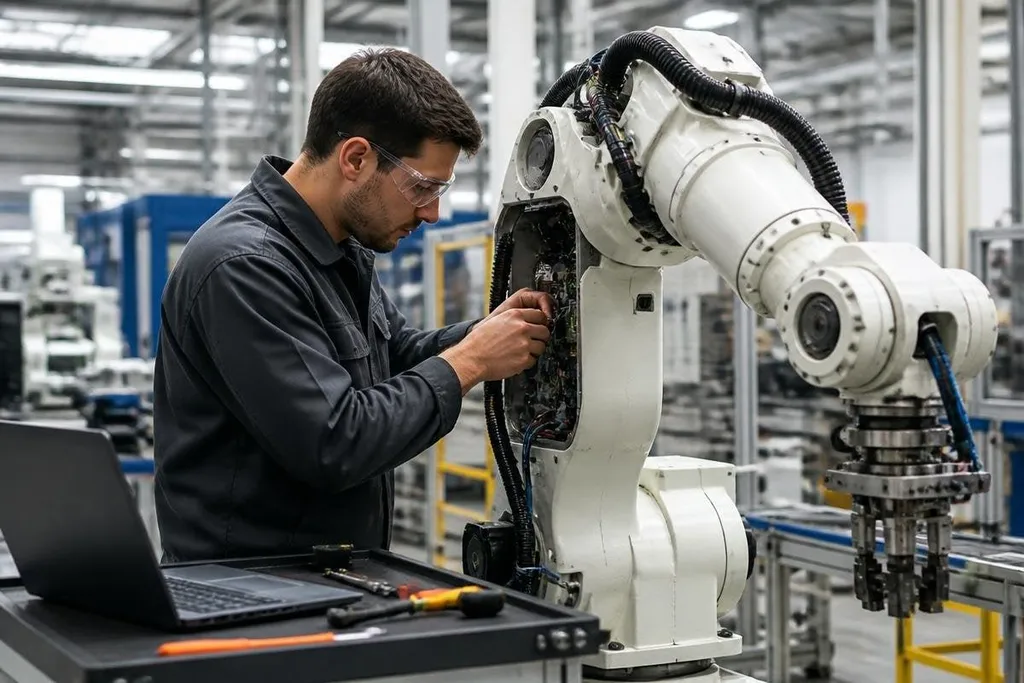
Robots only earn their keep when they keep working. As more companies put robotic arms, mobile robots, and automated equipment into daily operations, the people who inspect, repair, and tune those systems may find steady work.
The hardware gets attention. The service work decides whether it stays useful.
Quick read
- Robot maintenance combines mechanical work, electronics, software, and safety checks.
- The job suits technicians who like finding faults and fixing real equipment.
- Employers will still need training, clear service records, and safe work areas.
Why robots need people after installation
A robot can repeat the same motion for hours, but that repetition puts wear on motors, gearboxes, cables, grippers, sensors, and joints. Dust, heat, vibration, loose fasteners, and a damaged cable can turn a working cell into a stopped production line.
Maintenance workers check those parts before a fault stops the task. They may inspect a robot arm, test an emergency stop, clean a camera lens, replace a motor, or check whether a mobile robot still reads its map correctly. Each job needs a different mix of mechanical and electrical knowledge.
Software adds another layer. A robot may stop because a sensor failed, because a safety zone changed, or because a new program sends the arm along a path it can't safely reach. The technician has to separate the fault from the symptom, then return the system to a known safe state.
That work won't disappear when robots become easier to install. It may change from routine repairs to system checks, fault analysis, spare-parts planning, and software updates.
The skills behind the work
Robot maintenance sits between several trades. A technician may use a multimeter in the morning, read a wiring diagram before lunch, and check a robot controller in the afternoon.
The job also rewards careful records. A clear log can show when a fault began, which part was changed, and whether the same error returned after the repair. That record helps a team spot repeated failures instead of treating each stoppage as a separate event.
Training will need to cover more than one robot brand. A worker who understands motors, encoders, safety circuits, network links, and basic programming can move between many types of equipment, even when the control screens differ.
That range of skills will matter as more robot models move from trials into working sites. Robot maintenance coverage from Robot24.com can show which machines are being used and what service work they need. Those details point to the places where the jobs may appear.
Where the jobs may appear
Robot maintenance can support more than factory production. The same work can appear in warehouses, laboratories, hospitals, farms, ports, and field service teams, with each setting adding its own safety rules and working conditions.
A warehouse technician may deal with mobile robots, charging stations, lifts, and wireless links. A factory technician may spend more time with robot arms, grippers, fixtures, and safety fences. A field technician may travel to customer sites and fix equipment without a full workshop nearby.
The work will also vary by employer. Some teams may keep maintenance inside the company. Others may call a robot maker, system integrator, or specialist service firm when a fault needs deeper repair.
That variety gives the career path room to split into different roles. One person may focus on electrical repair, another on robot programming, and another on spare parts and service planning.
What could limit the career path
The job still has hard parts. A technician may need to work near moving equipment, lift heavy parts, follow lockout procedures, and stop work when a safety system does not behave as expected. A fast repair is never worth an unsafe restart.
Small companies may also buy robots without planning for service. If the maker keeps software tools closed or spare parts take too long to arrive, local technicians may struggle to fix the system. The value of the job depends partly on whether employers budget for maintenance from the start.
Some repairs will become easier as robots add better fault logs and remote checks. That may reduce certain routine tasks, but it can also leave technicians with harder faults that need sound judgment and wider system knowledge.
The open question is training. A short course can teach a control panel, but it can't replace time spent tracing faults on real equipment.
A practical test before you choose this path
Use this checklist before paying for a course or changing jobs:
- Check the equipment: Find out which robot brands and controllers local employers use.
- Read the course plan: Look for motors, sensors, safety circuits, wiring, and basic code.
- Ask about lab time: Hands-on fault finding matters more than watching repair videos.
- Learn the safety rules: Lockout procedures and emergency-stop checks belong in the training.
- Check service access: Ask whether the job includes maker support, spare parts, or travel.
- Try a small project: Build or repair a simple automated system before committing to a longer course.
I'd take robot maintenance seriously as a career path, but I'd choose a course with real equipment over one built around slides and product claims.
The machines may change quickly. Motors, sensors, wiring, safety checks, and fault records will still need people who can test them and fix what failed.